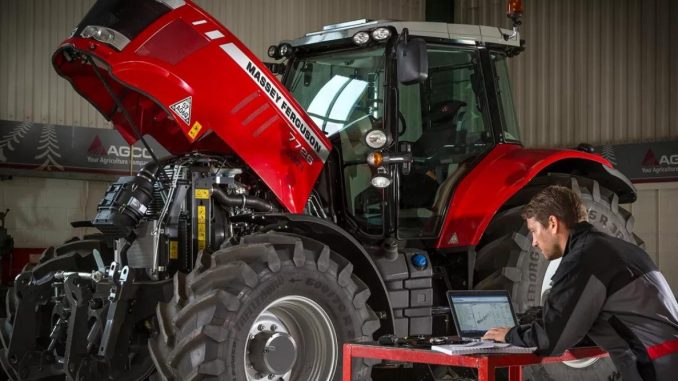
Introduction
If your AGCO machine displays fault code 382 – SPN 157 FMI 00, the engine management system has detected excessively high fuel rail pressure.
This fault indicates that the measured common rail pressure has exceeded the critical threshold of 1,700 bar (24,656 psi). Under normal operating conditions, the Pressure Release Valve (PRV) should open when Pressure reaches approximately 1,600–1,650 bar (23,206–23,931 psi).
If the PRV fails mechanically and cannot release excessive Pressure, the EEM3 engine management system continuously monitors the fuel rail pressure. When the measured Pressure exceeds 1,700 bar, the system immediately shuts down the engine to protect the fuel injection system.
This guide explains what AGCO fault code 382 means, its possible causes, and how to diagnose the problem systematically using the AGCO 2×4 CANUSB interface and 2026 AGCO EDT diagnostic software.
1. What Does AGCO Fault Code 382 – SPN 157 FMI 00 Mean?
Fault description: Rail Pressure HIGH
| Parameter | Description |
|---|---|
| Fault Code | 382 |
| SPN | 157 |
| FMI | 00 |
| Fault Description | Rail Pressure HIGH |
| Critical Pressure | Above 1,700 bar (24,656 psi) |
| Pressure Release Valve (PRV) | Normally opens at approximately 1,600–1,650 bar |
| Failure Severity | Most severe – Above normal operating range |
Understanding FMI 00
FMI 00 means the measured value is above the normal operating range and has exceeded the most severe limit defined for this fault.
When this condition occurs:
- The fault code is stored in the engine control system.
- The warning indicator is activated.
- An engine shutdown command is initiated.
- A CAN message indicates that engine shutdown is pending.
- The engine stops immediately when the critical pressure condition is detected.
Important: This is a serious high-pressure fuel system fault. Do not repeatedly restart the engine without identifying the cause.
2. Possible Causes of AGCO Rail Pressure High Fault
Several components can cause AGCO fault code 382. The main possibilities include:
| Possible Cause | What to Check |
|---|---|
| High-pressure fuel pump malfunction | Pump operation, wiring, connectors and control |
| Rail pressure sensor wiring damage | Open circuits, short circuits, corrosion or loose connections |
| Incorrect sensor power supply | Check the 5 V reference supply |
| Defective rail pressure sensor | Verify sensor readings and signal response |
| Pressure Release Valve (PRV) failure | Check for mechanical damage or malfunction |
| Defective engine control unit (EEM3 ECU) | Verify ECU operation and sensor signal processing |
The fault code alone does not identify which component has failed. Proper testing is necessary before replacing parts.
3. What You Need for AGCO Fault Code Diagnosis
To diagnose this problem, prepare the following equipment:
- AGCO 2×4 CANUSB diagnostic interface
- 2026 AGCO EDT Diagnostic Software
- A compatible Windows laptop
- Access to the machine’s electrical and fuel system service information
Recommended diagnostic solution: AGCO 2×4 CANUSB + 2026 AGCO EDT Software
The AGCO diagnostic interface provides the communication connection between the machine’s electronic control system and the diagnostic laptop. AGCO EDT software supports diagnostic functions, including reading fault codes, monitoring available parameters, and performing applicable tests.
Before purchasing, confirm that the interface, software version, and machine configuration match your specific AGCO model and ECU.
4. How to Diagnose and Fix AGCO SPN 157 FMI 00
Follow these diagnostic steps to identify the source of excessive fuel rail pressure.
Step 1: Check the High-Pressure Fuel Pump
A malfunctioning high-pressure fuel pump can cause abnormal fuel pressure conditions.
Perform the following checks:
- Inspect the high-pressure fuel pump for visible damage or fuel leakage.
- Check the pump wiring harness and electrical connectors.
- Look for loose connections, damaged insulation, or corrosion.
- Use the supported Service Tool test function to evaluate pump operation.
- If needed, have an authorized Bosch diesel injection service center inspect the pump.
If the pump does not operate to specification, further testing or replacement may be necessary.
Step 2: Inspect the Rail Pressure Sensor Wiring
A damaged sensor circuit can cause the ECU to receive incorrect fuel pressure information.
Check the following:
- Inspect the rail pressure sensor wiring harness for cuts, cracks, or damaged insulation.
- Examine the sensor connector for loose pins or poor contact.
- Check the connector terminals for oxidation or corrosion.
- Verify proper continuity and no short circuits, per the wiring diagram.
Repair damaged wiring or connectors before continuing with the diagnosis.
Step 3: Check the Rail Pressure Sensor Power Supply
The rail pressure sensor requires a correct reference voltage to provide reliable measurements.
Use a suitable digital multimeter to check the sensor’s 5 V reference supply.
Diagnostic procedure:
- Locate the rail pressure sensor connector.
- Refer to the machine’s wiring diagram to identify the reference voltage, ground, and signal terminals.
- Check whether the reference supply is approximately 5 V.
- Inspect the ground circuit for excessive resistance or poor connections.
- Check the signal circuit according to the manufacturer’s specifications.
If the 5 V supply is missing or incorrect, investigate the wiring and ECU reference circuit before replacing the sensor.
Step 4: Check the Rail Pressure Sensor Operation
If the power supply and wiring are correct, the rail pressure sensor itself may be defective.
Use AGCO EDT diagnostic software, where supported, to monitor the available rail pressure parameters.
Compare the reported Pressure with the manufacturer’s specifications and other available diagnostic information.
Pay attention to:
- Whether the pressure reading is plausible for the engine’s operating condition.
- Whether the reading changes appropriately during supported operating tests.
- Whether the sensor signal is unstable or inconsistent.
- Whether the reported pressure conflicts with other diagnostic measurements.
If the sensor produces an incorrect signal despite a correct power supply and ground, test it per the manufacturer’s procedure and replace it if confirmed defective.
Step 5: Check the EEM3 Engine Control Unit (ECU)
If the high-pressure pump, sensor, wiring, and power supply have been checked, the EEM3 controller may need further investigation.
Where the manufacturer’s diagnostic procedure permits, compare the system operation using a verified compatible replacement EEM3 controller.
- If the fault is no longer present and the system operates correctly with the replacement controller, the original ECU may be defective.
- If the fault remains, continue investigating the fuel pressure control system and related wiring.
Do not replace the ECU based on the fault code alone. First, confirm the power supply, grounds, connector condition, and ECU compatibility.
5. How to Repair the AGCO Rail Pressure High Problem
After identifying the faulty component, take the appropriate corrective action:
| Confirmed Problem | Recommended Action |
|---|---|
| High-pressure pump malfunction | Repair or replace the pump after professional inspection |
| Damaged sensor wiring | Repair or replace the affected wiring harness |
| Incorrect 5 V supply | Diagnose and repair the reference voltage circuit |
| Defective rail pressure sensor | Replace the sensor according to the service procedure |
| Damaged pressure release valve | Have the PRV inspected and replaced by qualified personnel |
| Defective EEM3 ECU | Replace or repair the controller following manufacturer procedures |
After repairs:
- Reconnect all electrical components correctly.
- Perform the required system checks.
- Use AGCO EDT software to read the fault codes again.
- Verify the available rail pressure data.
- Confirm that the fault is no longer active and that the machine operates according to the manufacturer’s procedures.
Do not simply clear the fault code without correcting the underlying problem.
6. Recommended AGCO Diagnostic Tool: 2×4 CANUSB + 2026 AGCO EDT Software
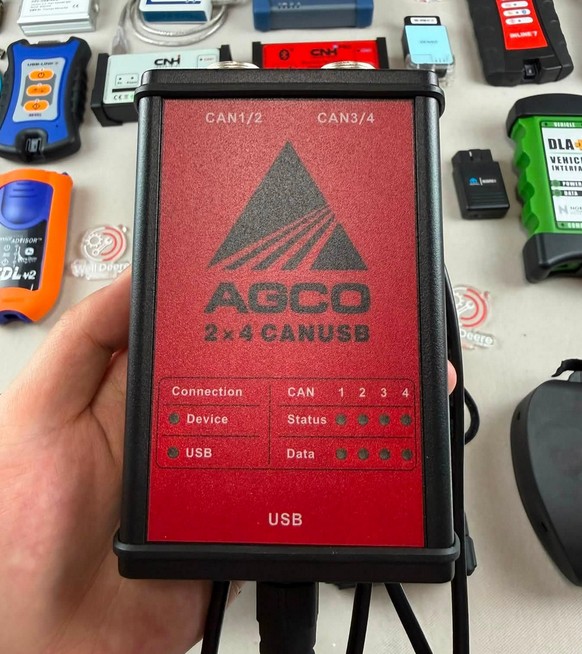
For technicians and workshops servicing AGCO agricultural equipment, having a compatible diagnostic interface and software can make electronic troubleshooting more efficient.
The AGCO 2×4 CANUSB interface with 2026 AGCO EDT Diagnostic Software provides a diagnostic connection for supported AGCO machine systems.
It can help technicians access available diagnostic information and investigate engine-related faults, including fuel pressure problems.
Why use AGCO EDT diagnostic software?
- Read and identify supported AGCO fault codes.
- View available engine and sensor parameters.
- Assist with electronic system troubleshooting.
- Perform supported diagnostic tests.
- Help verify repairs after component replacement.
Check out the AGCO diagnostic solution at OBDII.shop:
AGCO 2×4 CANUSB Diagnostic Interface + 2026 AGCO EDT Software
Contact OBDII.shop to confirm the product listing, supported AGCO models, software version, and compatibility before ordering.
7. Important Safety Precautions
Common rail diesel fuel systems operate at extremely high pressures. A pressure level of 1,700 bar is capable of causing serious injection injuries.
Keep the following precautions in mind:
- Never loosen high-pressure fuel pipes while the engine is running.
- Never check for fuel leaks using your hands.
- Follow the manufacturer’s pressure-relief and depressurization procedures before opening the fuel system.
- Use appropriate protective equipment.
- Have qualified diesel injection specialists perform high-pressure pump, rail, and PRV repairs.
- Follow the manufacturer’s service manual for component removal, inspection, and replacement.
High-pressure fuel system repairs should only be performed by personnel with the appropriate training and equipment.
Conclusion
AGCO fault code 382 – SPN 157 FMI 00 Rail Pressure HIGH indicates that common rail pressure has exceeded the critical operating threshold. Possible causes include a malfunctioning high-pressure fuel pump, defective rail pressure sensor, wiring problems, PRV failure, or an EEM3 ECU fault.
The correct approach is to inspect the fuel pump, verify the sensor wiring and 5 V supply, test the rail pressure sensor, and investigate the ECU only after the other possible causes have been evaluated.
A compatible AGCO 2×4 CANUSB interface and 2026 AGCO EDT diagnostic software help technicians access available diagnostic information and follow a more systematic troubleshooting process.
Need an AGCO diagnostic solution? Visit OBDII.shop to check the available AGCO diagnostic interface and software options.
Leave a Reply