Air trapped in the fuel system of a Fendt 900 Vario tractor can cause hard starting, extended cranking, unstable idle, loss of power, or an engine that starts and then stalls.
This commonly happens after:
- Replacing a fuel filter
- Draining the fuel system
- Running the tractor out of diesel
- Opening a low-pressure fuel line
- Servicing the fuel pre-filter or water separator
- Repairing a fuel supply hose
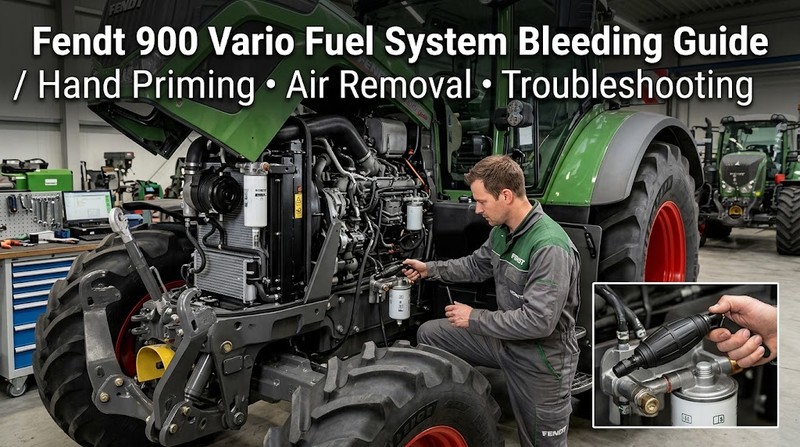
The correct solution is to prime and bleed the low-pressure side of the fuel system. Never attempt to remove air by loosening common-rail injector pipes.
This guide covers both fuel-system arrangements commonly described in Fendt 900 Vario workshop information: Version I and Version II.
Critical Safety Warning: Do Not Open Common-Rail Fuel Lines
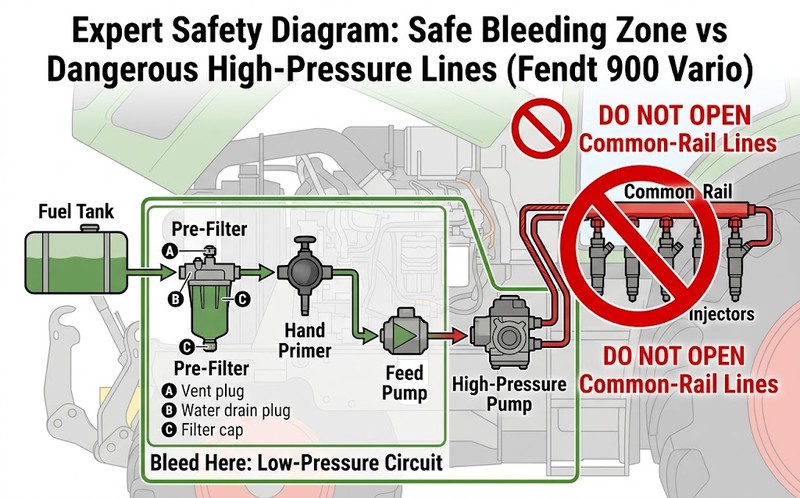
The Fendt 900 Vario uses a high-pressure common-rail injection system on applicable engine generations.
Never loosen an injector pipe, common-rail connection, high-pressure pump line, or other high-pressure fitting to bleed the system.
High-pressure diesel can penetrate the skin and cause severe injury.
Fendt workshop instructions specifically warn against opening the high-pressure system during bleeding. Remove air through the low-pressure fuel circuit and hand primer, not through the injector lines.
Wear:
- Safety glasses
- Fuel-resistant gloves
- Suitable workshop clothing
Keep ignition sources away from spilled diesel and clean any fuel leakage before starting the engine.
Quick Answer: How Do You Bleed a Fendt 900 Vario Fuel System?
For most Fendt 900 Vario configurations:
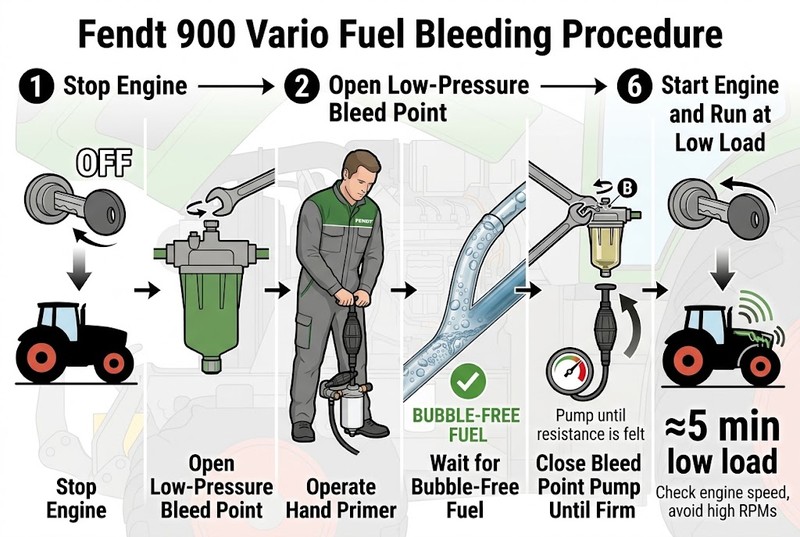
- Stop the engine.
- Locate the fuel hand primer.
- Pump the hand primer to fill the low-pressure circuit.
- If necessary, open the bleed screw or vent plug on the fuel pre-filter.
- Continue pumping until diesel comes out without visible air bubbles.
- Close the bleed screw.
- Continue operating the hand pump until you feel firm resistance.
- Give the primer several additional strokes.
- Start the engine.
- Check carefully for fuel leaks.
- Operate the tractor under low load for approximately 5 minutes so remaining air can clear from the system.
The exact bleed-point location depends on the fuel-filter arrangement installed on the tractor.
When Does a Fendt 900 Vario Need Fuel-System Bleeding?
Bleeding is normally required whenever air has entered the low-pressure fuel circuit.
Typical symptoms include:
Engine cranks but does not start.
If you just changed a filter, the filter housing and supply line may still contain air.
Engine starts and then stalls.
The engine may consume the small amount of fuel available in the injection system before an air pocket reaches the supply pump.
Long cranking after fuel-filter replacement.
This often means the primer has not filled the filter.
Engine runs unevenly immediately after service.
Small quantities of remaining air can temporarily disturb fuel delivery.
Hand primer never becomes firm.
This is particularly important. If repeated pumping produces little or no resistance, do not simply continue cranking the engine.
Check for:
- Low fuel level
- Loose fuel-filter housing
- Incorrectly installed filter seal
- Damaged O-ring
- Loose hose connection
- Air leaking into the suction line.
- Blocked fuel filter
- Restricted pre-filter
- Contaminated water separator
- Faulty hand primer
Fendt workshop troubleshooting information specifically identifies fuel starvation, filter restriction, water-separator contamination, and hand-pump leakage as possible causes of insufficient low-pressure fuel supply.
Before You Start
Basic Equipment
For normal manual bleeding, you generally need:
- Clean diesel fuel
- Protective gloves and eyewear
- Container for discharged fuel
- Clean workshop towels
- Basic hand tools if required for the bleed screw
Diagnostic Tools
You typically don’t need a diagnostic computer to bleed the low-pressure fuel circuit.
However, diagnostic equipment becomes useful if the tractor still does not start or develops fuel-pressure faults after bleeding.
Depending on the exact Fendt 900 Vario generation, engine, ECU, and diagnostic architecture, technicians may encounter tools such as:
- AGCO EDT
- Fendt FENDIAS
- Deutz SerDia
- Compatible AGCO/Fendt CAN diagnostic interfaces
Do not assume every Fendt 900 Vario generation uses the same engine-management software. Select the diagnostic platform according to the tractor’s serial number, generation, engine, and ECU.
Fendt 900 Vario Fuel-System Bleeding — Version I
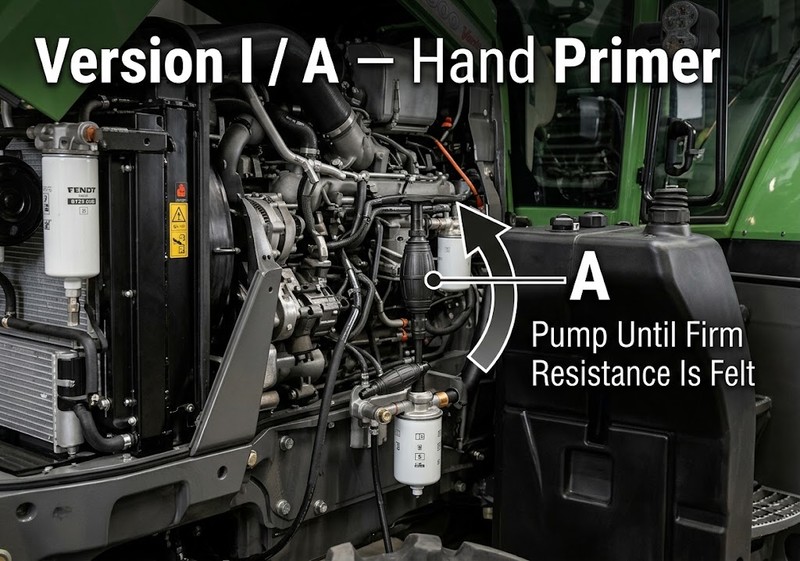
Use this procedure when the tractor has the Version I fuel-filter arrangement.
Step 1: Prime the System with the Hand Pump
Locate the fuel hand pump (A).
Operate the pump repeatedly to move diesel from the tank through the low-pressure supply circuit.
If the tractor has only a small amount of air in the system, this may be sufficient.
Step 2: Bleed the Low-Pressure Circuit if Required
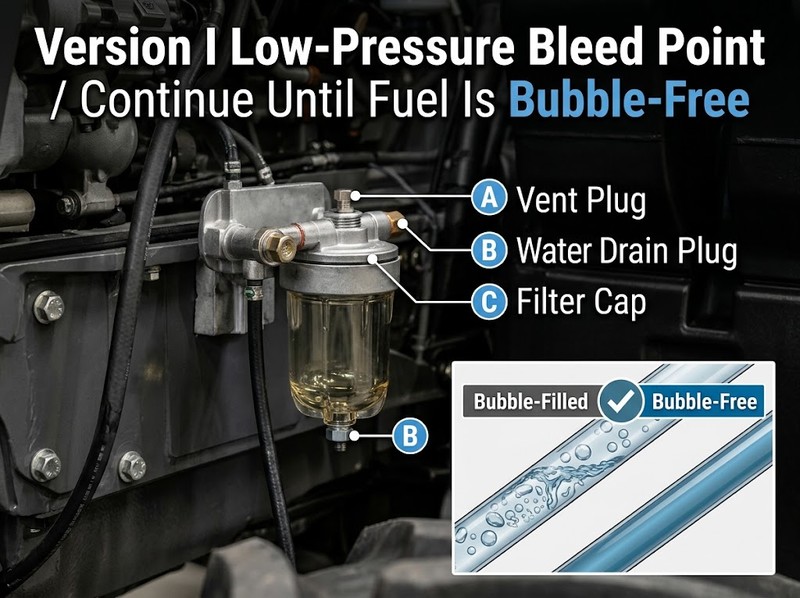
If the engine still does not start, or if you feel the primer moving air rather than fuel, manually bleed the pre-filter.
Locate:
- A — Vent plug
- B — Water drain plug
- C — Filter cap
Loosen the vent plug (A).
Do not remove unrelated plugs or open any high-pressure connections.
Step 3: Pump Until the Fuel Is Bubble-Free
Operate the hand primer.
Watch the fuel coming from the vent point.
Initially you may see:
- Foam
- Small bubbles
- Interrupted fuel flow
- A mixture of air and diesel
Continue pumping until you have a continuous stream of fuel with no visible air bubbles.
This is the important part of the procedure. Closing the vent while air is still leaving the filter can result in difficult starting or unstable running.
Step 4: Close the Vent Plug
Once clean, bubble-free diesel is flowing:
- Stop pumping.
- Close the vent plug securely.
- Wipe away spilled diesel.
Do not overtighten a plastic filter housing or bleed fitting.
Step 5: Continue Priming
Pump the hand primer again until you feel strong resistance.
Once resistance has developed, give the pump several additional strokes.
A firm primer indicates the low-pressure circuit has filled with fuel.
If the primer never becomes firm, investigate the supply system rather than repeatedly cranking the engine.
Step 6: Start the Engine
Start the tractor normally.
Avoid excessive continuous cranking.
Once the engine starts, allow it to stabilize briefly.
Check the fuel-filter housing, bleed screw, hoses, water separator, and recently serviced connections for leaks.
Step 7: Run the Tractor Under Low Load
Air remaining farther downstream can temporarily cause common-rail pressure fluctuations.
For this reason, after successful starting, operate the tractor at low load for approximately 5 minutes rather than immediately applying full engine load.
Monitor for:
- Rough running
- Engine warning messages
- Abnormal RPM fluctuation
- Fuel-pressure faults
- Fuel leakage
If the engine runs smoothly after this period, the bleeding procedure is normally complete.
Fendt 900 Vario Fuel-System Bleeding — Version II
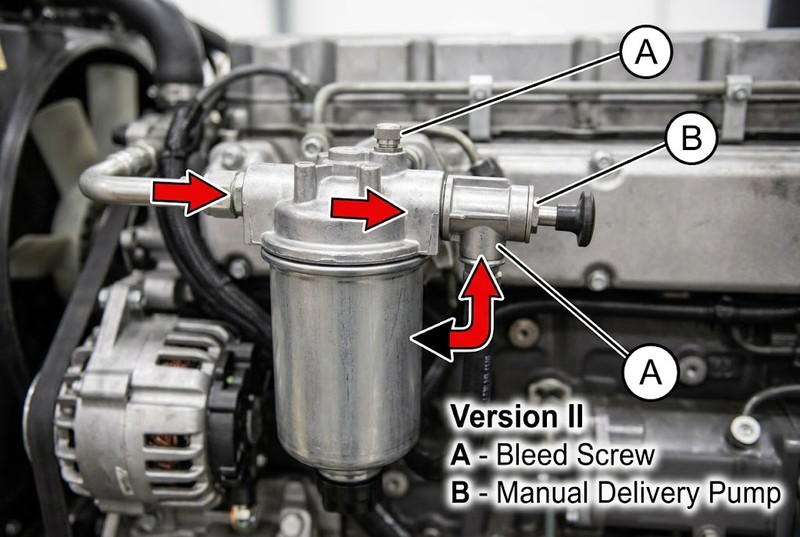
Some Fendt 900 Vario tractors use a different pre-filter arrangement.
For this configuration:
- A — Fuel pre-filter bleed screw
- B — Manual delivery pump
Step 1: Open the Fuel Pre-Filter Bleed Screw
Stop the engine.
Locate the bleed screw (A) on the fuel pre-filter and open it carefully.
Position a suitable container or absorbent material underneath the bleed point.
Step 2: Operate the Manual Delivery Pump
Pump the manual delivery pump (B) repeatedly.
Continue until:
- Fuel fills the pre-filter
- Air stops escaping
- Pumping resistance becomes noticeably stronger.
Continue pumping for several additional strokes after resistance develops.
Step 3: Close the Bleed Screw
Close the fuel pre-filter bleed screw.
Clean any spilled diesel from the surrounding components.
Check that the bleed screw is properly sealed.
Step 4: Start the Engine
Start the engine normally.
It may take slightly longer than usual on the first attempt because small amounts of air can remain downstream of the filter.
Do not attempt to speed up the process by loosening an injector pipe.
Step 5: Run at Low Load
Once the engine runs steadily, operate the tractor under low load for approximately 5 minutes.
This allows residual air to work its way through the system while minimizing the effect of temporary rail-pressure fluctuations.
Fendt 900 Vario Will Not Start After Bleeding: What to Check
If you completed the procedure correctly but the engine still refuses to start, more priming isn’t always the answer.
Work through the fuel system logically.
1. Does the Hand Primer Become Firm?
Yes
Fuel is probably reaching and filling the low-pressure circuit.
Move on to electronic diagnosis and actual fuel-pressure checks if the engine still will not start.
No
Suspect a supply-side problem such as:
- Fuel tank empty or very low
- Blocked tank pickup
- Restricted fuel hose
- Loose suction-side fitting
- Damaged filter seal
- Filter installed incorrectly
- Clogged filter element
- Water separator blockage
- Defective hand primer
- Air leak between tank and feed pump
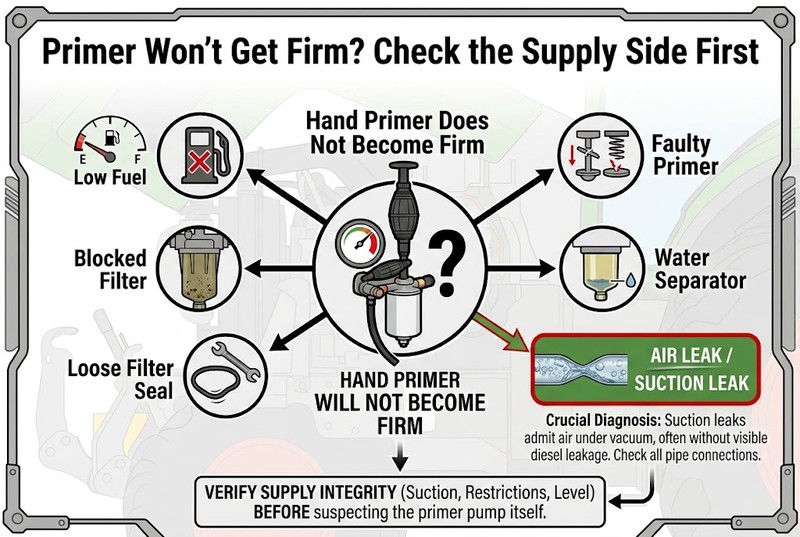
A suction-side leak is especially deceptive because it may draw air into the line without producing an obvious external diesel leak.
Engine Starts but Stalls Again
If the tractor starts immediately after priming but dies soon afterward, the system may be drawing air continuously.
Pay particular attention to anything recently disturbed.
Check:
- Fuel-filter O-rings
- Filter housing
- Water-separator seal
- Bleed screw
- Drain plug
- Fuel hose quick-connectors
- Suction hoses
- Hand-primer seals
A twisted, pinched, dry, or improperly seated filter seal can allow air into the system.
Engine Runs Rough After Bleeding
A short period of uneven running immediately after the repair can be caused by residual air.
However, the engine should progressively stabilize.
If rough running continues after the low-load purge period, don’t assume more air is the only problem.
Check for:
- Active engine fault codes
- Unstable low-pressure fuel supply
- Abnormal rail-pressure actual value
- Rail-pressure target versus actual mismatch
- Restricted fuel filter
- Fuel contamination
- Water in the fuel
- Faulty low-pressure supply
- Injector-related faults
- Rail-pressure control faults
At this point, electronic diagnosis becomes useful.
When Should You Connect AGCO EDT, FENDIAS, or SerDia?
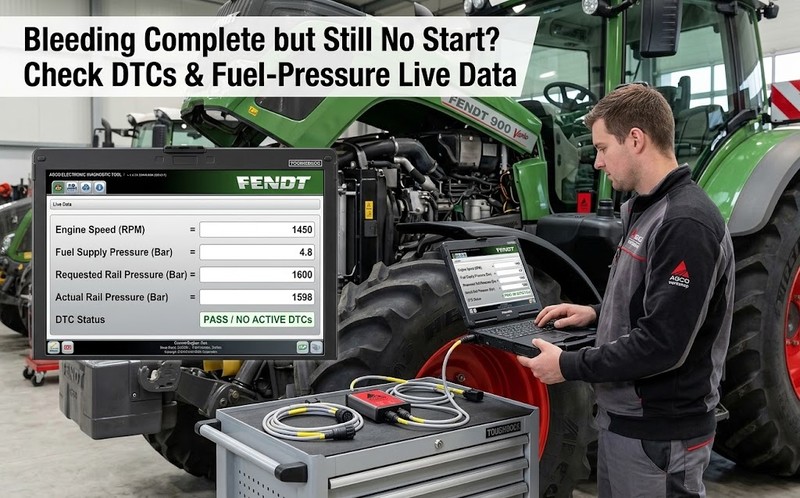
Normally, complete manual priming first.
Use diagnostic software when:
- The engine still will not start.
- A fuel-pressure fault is stored.
- The engine starts but repeatedly stalls.
- Rail pressure is unstable.
- Low-pressure fuel delivery is suspected.
- An engine ECU warning remains active.
- Engine performance remains poor after successful bleeding.
A professional diagnostic workflow is:
Fuel supply → Manual bleeding → Leak inspection → Fault-code scan → Live-data analysis → Pressure testing
This is much more effective than replacing fuel-system components based only on a no-start symptom.
Useful Live Data to Check
Exact parameter names vary by ECU and software version, but technicians should look for values related to:
Engine Speed During Cranking
The ECU needs a valid engine-speed signal before normal injection can occur.
If engine speed remains at zero while cranking, investigate crankshaft-speed sensing rather than the fuel filter.
Fuel Low Pressure
Low supply pressure can prevent the high-pressure pump from operating correctly.
Fendt workshop information for certain 900 Vario fuel systems specifies approximately 6 bar at the relevant low-pressure test location. This is a workshop pressure-test specification and should not be assumed to apply unchanged to every 900 Vario generation.
Requested Rail Pressure
This is the pressure the engine ECU is trying to achieve.
Actual Rail Pressure
Compare actual rail pressure with the requested value while cranking and running.
A large difference can indicate a problem that requires further diagnosis.
Fuel-Pressure Related DTCs
Always record fault codes before deleting them.
A stored code can identify whether the problem concerns:
- Low-pressure supply
- Rail-pressure control
- Pressure sensor plausibility
- Metering valve
- Engine speed synchronization
- Injector control
Do Not Diagnose a High-Pressure Fault Until the Low-Pressure Side Is Correct
This is one of the most useful rules when diagnosing a common-rail diesel.
The high-pressure pump cannot operate normally if it is being supplied with:
- Air
- Insufficient fuel
- Restricted fuel
- Contaminated fuel
Therefore, if rail pressure is too low after a filter change, first confirm that the filter and low-pressure circuit are completely primed and free of air.
Do not immediately condemn the high-pressure pump.
What If No Fuel Comes Out of the Bleed Screw?
If repeated operation of the primer produces no diesel at the bleed point:
- Check that the tank has sufficient diesel.
- Verify that you opened the correct bleed screw.
- Inspect the fuel supply line from the tank.
- Inspect the pre-filter for blockage.
- Check the filter installation.
- Look for damaged or incorrectly installed seals.
- Check the water separator.
- Inspect the hand primer.
Fendt workshop troubleshooting information lists fuel starvation, filter restriction, contaminated pre-filter/water separator, and hand-pump problems among possible causes of inadequate low-pressure delivery.
What If Air Bubbles Keep Returning?
A few bubbles immediately after opening the system are normal.
A continuous stream of bubbles after prolonged priming is not.
That usually means air is entering somewhere on the suction side.
Inspect connections between the fuel tank and supply pump, especially:
- Hose clamps
- Quick connectors
- Filter seals
- Pre-filter housing
- Water drain
- Bleed screw
- Primer assembly
Remember that a suction-side air leak may not leak diesel externally.
Common Mistakes to Avoid
Opening an Injector Line
Do not bleed a common-rail Fendt by cracking an injector pipe.
It is unnecessary and potentially dangerous.
Cranking the Engine Repeatedly Instead of Priming
If the low-pressure circuit contains a large air pocket, extended starter operation is not an efficient substitute for proper hand priming.
Closing the Bleed Screw Too Early
Continue priming until the discharged diesel contains no visible bubbles.
Ignoring the Fuel Filter Seal
If the problem appeared immediately after a filter replacement, recheck the parts that were just serviced before suspecting an ECU, injector, or high-pressure pump.
Applying Full Load Immediately
Let the engine stabilize and run under low load for about five minutes after bleeding.
Assuming All Fendt 900 Vario Models Are Identical
The 900 Vario family has been produced across several generations with different engine and fuel-system arrangements.
Always identify the tractor by:
- Model
- Generation
- Serial number
- Engine type
- Fuel-filter configuration
before applying detailed pressure specifications or diagnostic procedures.
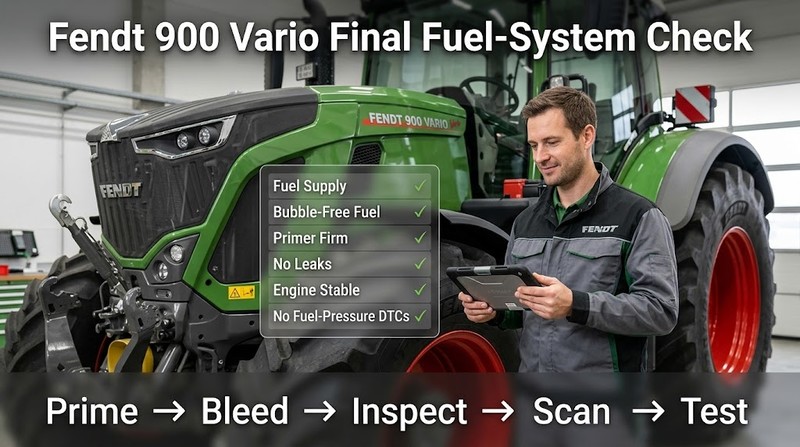
Final Bleeding Checklist
Before returning the tractor to service, confirm:
Fuel tank contains sufficient clean diesel.
Low-pressure circuit has been primed.
Fuel at the bleed point is free of visible air bubbles.
Bleed screw or vent plug is closed.
Hand primer develops firm resistance.
Filter housing is correctly sealed.
Water drain is closed.
No fuel leaks are present.
Engine starts normally
Idle becomes stable
Operate the tractor under low load for about 5 minutes.
No fuel-pressure warning remains active.
No abnormal rail-pressure fault returns.
Frequently Asked Questions
Do I need diagnostic software to bleed a Fendt 900 Vario fuel system?
Usually no. Normal bleeding is performed mechanically using the hand primer and, when required, the bleed screw on the low-pressure fuel circuit.
Diagnostic software is useful if the tractor still will not start or fuel-pressure faults remain after the system has been correctly primed.
Can I loosen the injector lines to remove air?
No. Do not loosen common-rail injector or high-pressure fuel lines to bleed the system.
Bleed the low-pressure side with the hand primer.
How do I know when the fuel system is fully primed?
Two useful signs are:
- Fuel leaving the bleed point contains no visible air bubbles.
- The hand primer develops strong resistance.
Why won’t the hand primer get hard?
Possible causes include an air leak, low fuel level, a blocked supply line, a clogged filter, an incorrectly installed filter seal, a contaminated pre-filter, or a faulty hand primer.
Why does the tractor run roughly after bleeding?
A small quantity of residual air may temporarily disturb fuel pressure. Run the tractor at low load for approximately five minutes and monitor operation.
If rough running continues, scan the engine ECU and check actual fuel-pressure values and stored fault codes.
Should I use AGCO EDT or Deutz SerDia?
That depends on the tractor generation and engine-management system.
AGCO/Fendt diagnostic software may suit tractor-level diagnosis, while Deutz engine diagnostic software applies only to compatible Deutz-powered configurations.
Identify the exact tractor and engine before choosing diagnostic software.
Conclusion
Bleeding the fuel system on a Fendt 900 Vario is primarily a low-pressure fuel-system procedure.
The safest sequence is:
Prime the hand pump → vent trapped air → close the bleed point → pump until firm → start the engine → check for leaks → operate at low load for about five minutes.
Never open common-rail injector lines to remove air.
If the hand primer does not become firm, bubbles continually return, or the engine still will not start after correct bleeding, stop treating the problem as a simple air lock. Inspect the low-pressure supply system for restrictions and air leaks, then use the appropriate Fendt/AGCO or engine diagnostic software to evaluate fault codes and fuel-pressure data.
That approach prevents unnecessary parts replacement and, more importantly, avoids unsafe work on the high-pressure common-rail system.
Leave a Reply